
What the Bristol Living Compost Project Is Teaching Us About Letting Go of “Waste”
Waste is a powerful word. Once something is labelled as waste, it becomes easy to stop paying attention to it. We remove it from sight, responsibility, and imagination.
The Bristol Living Compost Project challenges that idea, showing that food waste is not a problem to be managed but a resource that has simply lost its place in the system.
By turning food waste into living compost through local, community-led processes, the project is helping Bristol rethink what waste really is and what becomes possible when we let go of that label.

Waste Is a Design Outcome, Not a Material Truth
In nature, there is no such thing as waste. Leaves fall, decompose, and feed soil. Organic matter breaks down and becomes the foundation for new life. Nutrients move in cycles.
Waste only appears when those cycles are broken.
Modern food systems are largely linear. Food is grown, transported, consumed, and discarded, often far from the soil that produced it. Once nutrients are removed from local systems, they lose their value and become something to dispose of.
The Bristol Living Compost Project treats food waste as a signal of disconnection rather than failure. When nutrients are kept local and returned to soil, waste disappears and value re-emerges.
Reframing Food Waste as a Soil Resource
At the heart of the Bristol Living Compost Project is a simple but profound shift. Food waste is not something to get rid of. It is something to return.
Through local composting in Bristol, food scraps from households and businesses are collected and transformed into living compost that supports active soil biology. This compost is then used to regenerate soils in the same city where the food was eaten.
This closes a visible loop. Kitchens reconnect with soil. Waste becomes nutrient. Responsibility becomes shared rather than outsourced.
When people know where their food waste goes, behaviour changes naturally. Waste stops feeling disposable and starts feeling meaningful.

Community Composting Changes Relationships
Community composting is not just a technical process. It is a cultural one.
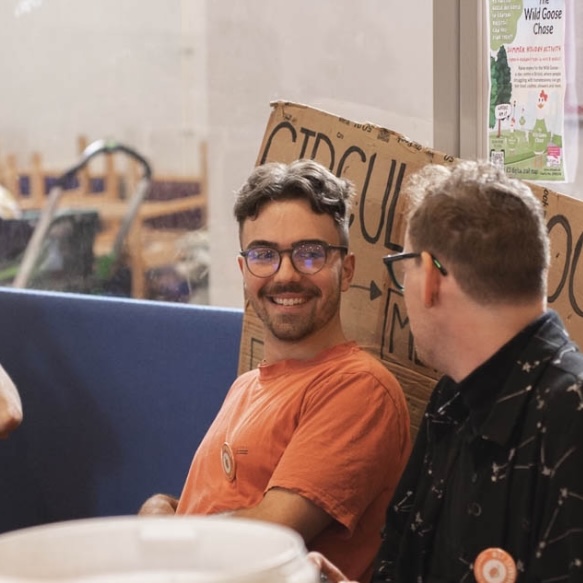
The Bristol Living Compost Project demonstrates how community compost builds relationships between people, place, and land. Participation replaces guilt. Learning replaces instruction. Care replaces compliance.
Rather than asking individuals to address food waste on their own, the project creates shared infrastructure that makes regenerative behaviour easier and more rewarding.
This approach reflects how living systems actually function. Change happens through participation, not pressure.

Living Compost Requires Letting Go of Control
Living compost systems cannot be rushed. They rely on microbial communities, fungal networks, moisture balance, and time.
Trying to control these systems too tightly often leads to poorer outcomes. When compost is forced to perform, biology becomes stressed and diversity declines.
By contrast, living compost systems thrive when they are observed, adjusted, and supported rather than fixed.
The Bristol Living Compost Project prioritises compost quality over speed. This patience allows microbial life to establish, nutrients to stabilise, and soil to benefit in the long term.
Letting go of waste also means letting go of the idea that faster is always better.
Why Local Loops Matter in Bristol
Bristol faces many of the same challenges as other cities. High food waste volumes, pressure on land, and disconnection from food production are common urban issues.
What makes the Bristol Living Compost Project distinctive is its commitment to keeping nutrients within the city.
Local composting reduces transport, lowers emissions, and ensures that food waste directly supports local soil health. This strengthens resilience at a neighbourhood level rather than exporting responsibility elsewhere.
By treating Bristol as a connected ecosystem rather than a collection of isolated processes, the project shows how circular systems can work in practice.
From Waste to Responsibility
Letting go of waste is not about ignoring problems. It is about redefining responsibility.
When food waste is seen as a resource, new questions emerge. Where should these nutrients go? Who benefits from them? How do we design systems that allow value to circulate rather than leak away?
The Bristol Living Compost Project offers one answer. By keeping food waste local and transforming it into living compost, responsibility returns to the community in a constructive and empowering way.
This is not about perfection. It is about participation.

What This Means for the Future of Food Systems
Rethinking waste is a necessary step toward regenerative food systems. Soil health, biodiversity, and climate resilience all depend on nutrients being returned to land rather than discarded.
Projects like the Bristol Living Compost Project show that this shift is possible at a city scale when systems are designed with care, biology, and people in mind.
Letting go of waste allows us to see food systems not as linear supply chains, but as living cycles that we are part of.
Joining the Loop
If you are interested in food waste, soil health, or community-led regeneration, the Bristol Living Compost Project offers a practical example of how change can happen locally.
By supporting local composting in Bristol, you help restore soil health, reduce waste, and strengthen community resilience.
To learn more about the project or explore how to get involved, visit the Bristol Living Compost Project page or read more about Generation Soil’s wider mission and approach to regenerative practice.
Frequently Asked Questions
What happens to food waste in the Bristol Living Compost Project?
Food waste is collected locally and transformed into living compost that supports active soil biology and local growing projects.
Is community composting suitable for cities like Bristol?
Yes. Community composting is particularly effective in urban areas where local loops reduce transport and strengthen neighbourhood resilience.
What makes living compost different from standard compost?
Living compost contains active microbial life that improves soil structure, nutrient cycling, and long-term soil health.
Can households and businesses both take part?
Yes. The Bristol Living Compost Project works with households, businesses, and community organisations across the city.


Comments