
Soil Bioacoustics: Listening to Living Soil
Understanding soil health through sound, vibration, and living systems
Soil is alive. Beneath our feet, billions of organisms move, feed, grow, and interact. Soil bioacoustics is an emerging field that explores how sound and vibration within soil can be used to understand biological activity, ecosystem health, and environmental change.
At Generation Soil, we explore soil bioacoustics as both a scientific approach and a public engagement practice. It offers a way to make invisible soil life perceptible, helping people experience soil as a living system rather than an inert material.
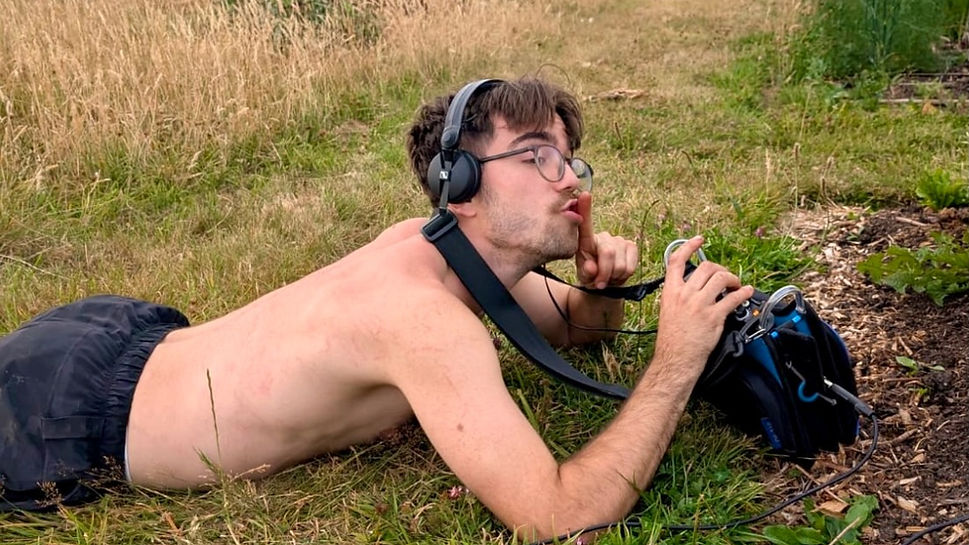
What is soil bioacoustics?
Soil bioacoustics is the study of sound and vibration generated by biological processes within soil. These signals may come from:
-
Invertebrate movement
-
Root growth
-
Fungal networks
-
Microbial activity
-
Interactions between soil organisms
The sounds themselves may be audible, sub-audible, or sensed as vibration transmitted through soil structure.
By recording and analysing these signals, researchers can gain insight into soil biodiversity, biological activity, and ecosystem dynamics without disturbing the soil.
Why soil is not silent
Healthy soil is dynamic. Movement, feeding, growth, and decay all generate vibration.
In biologically active soils, these interactions create complex acoustic patterns. In degraded or compacted soils, these signals may be reduced, simplified, or altered.
Listening to soil offers a way to:
-
Observe biological activity without excavation
-
Track changes over time
-
Complement chemical and physical soil measurements
This makes soil bioacoustics particularly relevant to regenerative land management and long-term ecological monitoring.
Soil bioacoustics and soil health
Traditional soil health assessments often focus on nutrients, structure, and chemistry. While valuable, these methods can miss biological dynamics.
Soil bioacoustics has the potential to complement existing approaches by:
-
Capturing real-time biological activity
-
Indicating levels of soil life and movement
-
Supporting holistic understanding of living soil systems
Rather than replacing established soil science, bioacoustics adds another layer of insight into how soil functions as a living ecosystem.

Applications of soil bioacoustics
Ecological and soil research
Researchers are exploring how acoustic signals relate to soil biodiversity, organism behaviour, and ecosystem function.
Regenerative agriculture and land management
Sound-based monitoring may help assess how soil biology responds to different management practices over time.
Environmental sensing and monitoring
Bioacoustic approaches could support low-impact, continuous monitoring of soil systems without repeated sampling.
Public engagement and education
Listening to soil offers a powerful way to communicate that soil is alive, complex, and worthy of care.
Soil bioacoustics as public engagement
At Generation Soil, we are especially interested in soil bioacoustics as a sensory and educational tool.
Hearing or visualising soil activity:
-
Makes abstract processes tangible
-
Encourages curiosity and care
-
Helps bridge the gap between scientific knowledge and lived experience
This aligns with our wider work in soil education, composting, and community-based learning.
Soil bioacoustics, composting, and living systems
Composting systems are biologically rich environments, making them ideal spaces for exploring soil bioacoustics in practice.
Living compost contains:
-
Dense microbial communities
-
Invertebrate movement
-
Rapid biological change
These systems offer opportunities to explore how acoustic activity shifts as food waste transforms into living soil.
Academic and interdisciplinary relevance
Soil bioacoustics sits at the intersection of:
-
Soil science
-
Ecology
-
Bioacoustics
-
Environmental sensing
-
Behavioural science
-
Human–environment interaction
At Generation Soil, we approach soil bioacoustics as a practice-based, exploratory field, grounded in real composting and soil systems rather than laboratory abstraction alone.
This makes it relevant to researchers, educators, artists, technologists, and community practitioners.
Research, collaboration, and exploration
We are interested in collaboration with:
-
Universities and research institutions
-
Students and early-career researchers
-
Artists, designers, and technologists
-
Community groups exploring soil and ecology
Our work is rooted in active composting and soil regeneration systems, offering opportunities for applied research, pilot projects, and public-facing experimentation.
Why soil bioacoustics matters now
Soil degradation, biodiversity loss, and climate change are deeply connected. Understanding soil as a living, responsive system is essential to addressing these challenges.
Soil bioacoustics offers:
-
New ways of sensing ecological change
-
Tools for monitoring regeneration
-
A shared language that connects science, practice, and public understanding
Listening to soil invites a shift from control to care.
Soil bioacoustics at Generation Soil
Soil bioacoustics forms part of our wider commitment to:
-
Living soil
-
Community composting
-
Regenerative food systems
-
Soil education and public engagement
It supports our aim to make soil visible, audible, and valued in everyday life.
Learn more or get involved
If you’re interested in soil bioacoustics, soil health research, or interdisciplinary collaboration, we’d love to hear from you.
You can also explore our work in:
-
Applied research and public engagement
testimonial

Turning my food waste into the best compost I've ever used! Couldn't be happier 💚