
What People Learn by Composting Together
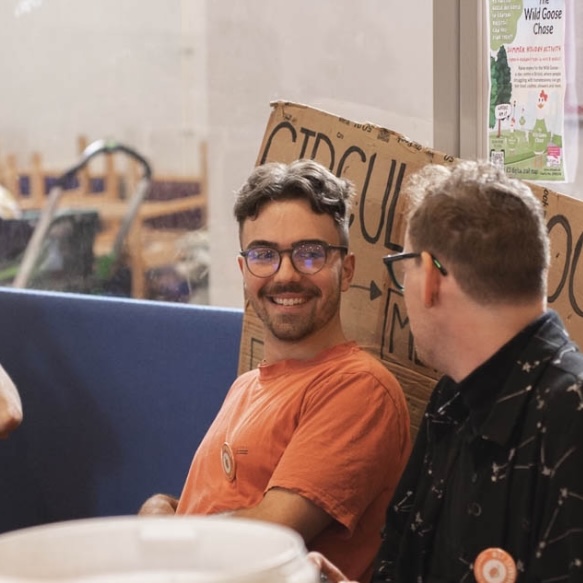
People often assume composting is something you learn first and then do.
You read instructions. You understand the rules. You apply them correctly.
In practice, it tends to work the other way round.
People learn by composting together.
Understanding grows through shared work, repeated contact and observation over time. Confidence follows experience, not the other way around.

Learning That Doesn’t Start With Information
Most people don’t lack information about composting.
They lack familiarity.
They haven’t handled decomposing food waste. They haven’t smelled fermentation. They haven’t seen a compost heap change over weeks and months.
Without that contact, composting stays abstract.
Community composting brings learning back into the body.
What Changes When Composting Is Shared
When composting happens in isolation, mistakes can feel personal.
When it happens together, mistakes become part of the process.

Confidence replaces anxiety
People see that compost can absorb variation.
Buckets arrive with different contents. Conditions change with weather. Systems adapt.
This reduces fear of getting it wrong. Confidence grows through seeing that imperfection is normal and manageable.
Smell becomes information
In shared composting spaces, smell is discussed rather than avoided.
People learn to distinguish between sharp, sour, earthy and sweet smells. Odour stops being a warning sign and becomes feedback.
This sensory learning cannot be conveyed well through written instructions alone.
Learning Through Repetition
Understanding composting is not a one-off event.
It builds through repetition.
Seeing similar processes unfold week after week allows patterns to emerge. People notice how moisture affects decomposition. How temperature rises and falls. How material changes over time.
This kind of learning is cumulative.
It settles.

Knowledge Moves Between People
In community composting systems, knowledge is not held by one expert.
It moves between participants.
Someone who learned last month explains something to someone new. Someone who was once unsure becomes confident enough to reassure others.
Learning becomes relational
This shared learning builds trust.
People feel able to ask questions without fear of judgement. They learn that uncertainty is expected, not a failure.
Composting becomes something you do with others, not something you perform alone.
Seeing the Whole System
Composting together makes systems visible.
People see how food waste connects to soil. How compost feeds gardens. How gardens feed people.
This systems understanding does not come from diagrams.
It comes from proximity.
Seeing material move through stages changes how people think about food waste more broadly.
From Task to Practice
When composting is shared, it stops being a task to complete.
It becomes a practice.
A regular activity embedded in weekly rhythms. Something people return to rather than tick off.
This continuity matters.
It allows learning to deepen and habits to stabilise.

What People Carry With Them
People don’t just learn how to compost.
They carry away confidence, language and judgement.
They become more comfortable handling organic material. More able to read soil. More aware of how systems respond to care.
These skills travel.
People take them to new gardens, new homes and new communities.
Learning That Stays Put
At the same time, community composting anchors learning in place.
People recognise where compost goes. They see soil improve in familiar locations. They associate learning with real outcomes.
This connection to place strengthens commitment.
The work feels grounded rather than abstract.
Why This Kind of Learning Matters
Food systems are complex.
Explaining them fully is difficult. Experiencing them is easier.
Learning by composting together bypasses debate and abstraction. It builds understanding through participation.
This kind of learning is slower.
But it lasts.
Learning Follows Participation
People do not need to understand everything before they take part.
They need systems that allow them to join safely and imperfectly.
When participation comes first, learning follows naturally.
Composting together creates that condition.


Comments