
From Waste to Resource: Why Food Waste Policy Needs a Regenerative Shift
The Problem With the Word “Waste”

Every week, millions of tonnes of food are discarded across the UK: scraps, peelings, leftovers, and supermarket surplus that could have nourished both people and soil.
Food waste is not just an environmental issue; it is a systems issue.
It reveals how we value resources, relationships, and regeneration.
Right now, UK food waste policy focuses on diversion rather than renewal. Most of our organic waste ends up in anaerobic digestion (AD) plants, huge industrial facilities that turn food waste into biogas and digestate. It is cleaner than landfill, yes, but it is still linear.
It takes what is living and reduces it to energy. It manages decay rather than cultivating life.
If we want to build food systems that truly heal the planet, we need to stop treating food waste as a liability and start treating it as living material.
How Current Policy Keeps Us Linear

The UK’s food waste framework, built around efficiency and compliance, still operates under a Victorian principle: get waste out of sight, as fast as possible.
Local councils are rewarded for tonnage diverted, not soil restored. Waste contracts are judged on throughput, not nutrient return.
Even progressive measures such as separate food waste collections often funnel scraps into centralised AD systems, where the material’s biological value is lost. The resulting digestate may be nutrient-rich, but it is often biologically poor, lacking the microbial life that makes soil thrive.
The outcome?
A “circular economy” that looks good on paper, but does not regenerate the ground beneath our feet.
The Regenerative Alternative

At Generation Soil, we see food waste differently.
Every banana peel, coffee ground, and carrot top is part of a living cycle that can repair ecosystems, store carbon, and rebuild soil fertility.
Our work in Bristol through the Bristol Living Compost Project shows what is possible when food waste is kept local, microbial, and community-powered.
Instead of shipping waste miles away to digesters, residents drop their scraps into local compost hubs.
Instead of losing organic matter to energy plants, we return it directly to the soil – rich with microbial diversity, ready to feed new life.
This is not waste management. It is nutrient stewardship.
And it is the foundation of a truly regenerative city.
Why the System Needs a Policy Shift
Right now, local composting projects like ours exist around the edges of the formal system. They are underfunded, under-recognised, and often treated as feel-good extras rather than vital infrastructure.
But the science tells us otherwise.
Healthy soils underpin everything: food security, flood resilience, carbon storage, and biodiversity.
Policies that only measure waste diversion miss the most significant opportunity of all – to rebuild soil as living infrastructure.
A regenerative policy framework would:
Reward nutrient return, not just waste reduction
Support community-scale composting alongside industrial systems
Invest in soil regeneration metrics, not only emissions data
Integrate composting with urban greening, education, and health
This is not radical. It is what cities such as Surabaya in Indonesia already do. When just 20% of households composted food waste locally, landfill volumes dropped by 30%.
It is proof that community composting can scale, if policy allows it to.
The Science of Regeneration

Compost is not just decomposed matter. It is a living ecosystem made up of billions of bacteria, fungi, protozoa, and nematodes working in symbiosis.
This microbial life performs functions that no fertiliser or chemical input can replicate:
Recycling nutrients into plant-available forms
Improving soil structure to prevent erosion
Storing carbon in stable organic matter
Filtering water and detoxifying pollutants
When food waste is processed in industrial systems, much of this microbial diversity is destroyed.
When it is composted locally and returned to land, we regenerate not just soil but the living relationships that sustain it.
A Tale of Two Cities: Bristol vs. the National Model
In Bristol, our Victorian waste infrastructure still shapes what is possible.
Food waste is collected, transported, and treated centrally. While efficient, it creates a disconnection; residents do not see where their waste goes or what happens to it.
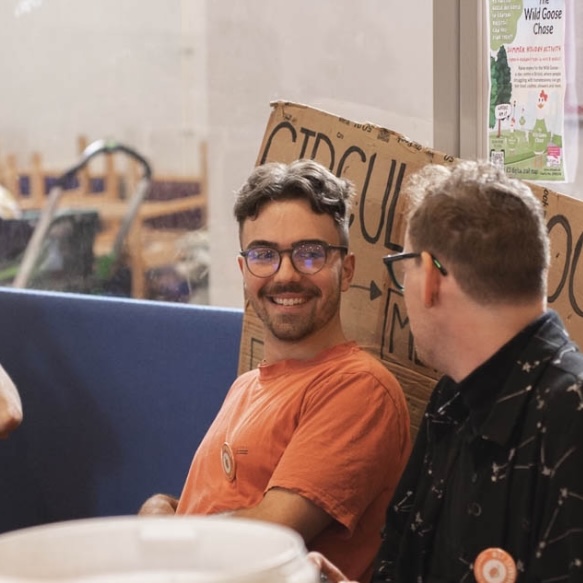
Through the Bristol Living Compost Project, we are rebuilding that connection from the ground up.
Every bucket filled, every workshop hosted, every handful of living compost shared is a step toward a more circular and resilient city.
Policy Recommendations for a Regenerative Future
To truly shift from waste to resource, the UK needs to embed regeneration in law and practice.
Here is what that could look like:
Fund Local Composting Infrastructure
Create grants and low-barrier funding for community-led composting hubs like those in Bristol, Birmingham, and Glasgow.
Integrate Soil Health into Food Waste Reporting
Move beyond weight metrics – measure soil organic carbon, biodiversity, and nutrient density as key outcomes.
Decentralise Waste Management
Allow local authorities to pilot small-scale, distributed models that reduce transport emissions and strengthen community engagement.
Support Citizen Science and Education
Empower schools, gardeners, and households to monitor soil health, turning composting into a civic act of learning and care.
Align Climate and Soil Policy
Recognise soil regeneration as a form of climate adaptation, not just mitigation.
A Call to Reimagine

At Generation Soil, we are proving that small, local actions can rewrite the story of waste.
If policy caught up with practice, if we truly designed systems that returned nutrients to the ground rather than extracted them, we could transform our food waste challenge into a soil revolution.
The future of sustainable cities begins with what we do with our scraps.
It is time to stop managing waste and start growing life.


Comments